Building a Wolt-wide voice system for people and AI
I led a tone of voice revamp and built a content GPT alongside it. Together, they made Wolt’s product voice specific enough for anyone to write in, including AI.
The GPT rolled out to every product designer at Wolt, and copy requests to content design dropped by over 80%.
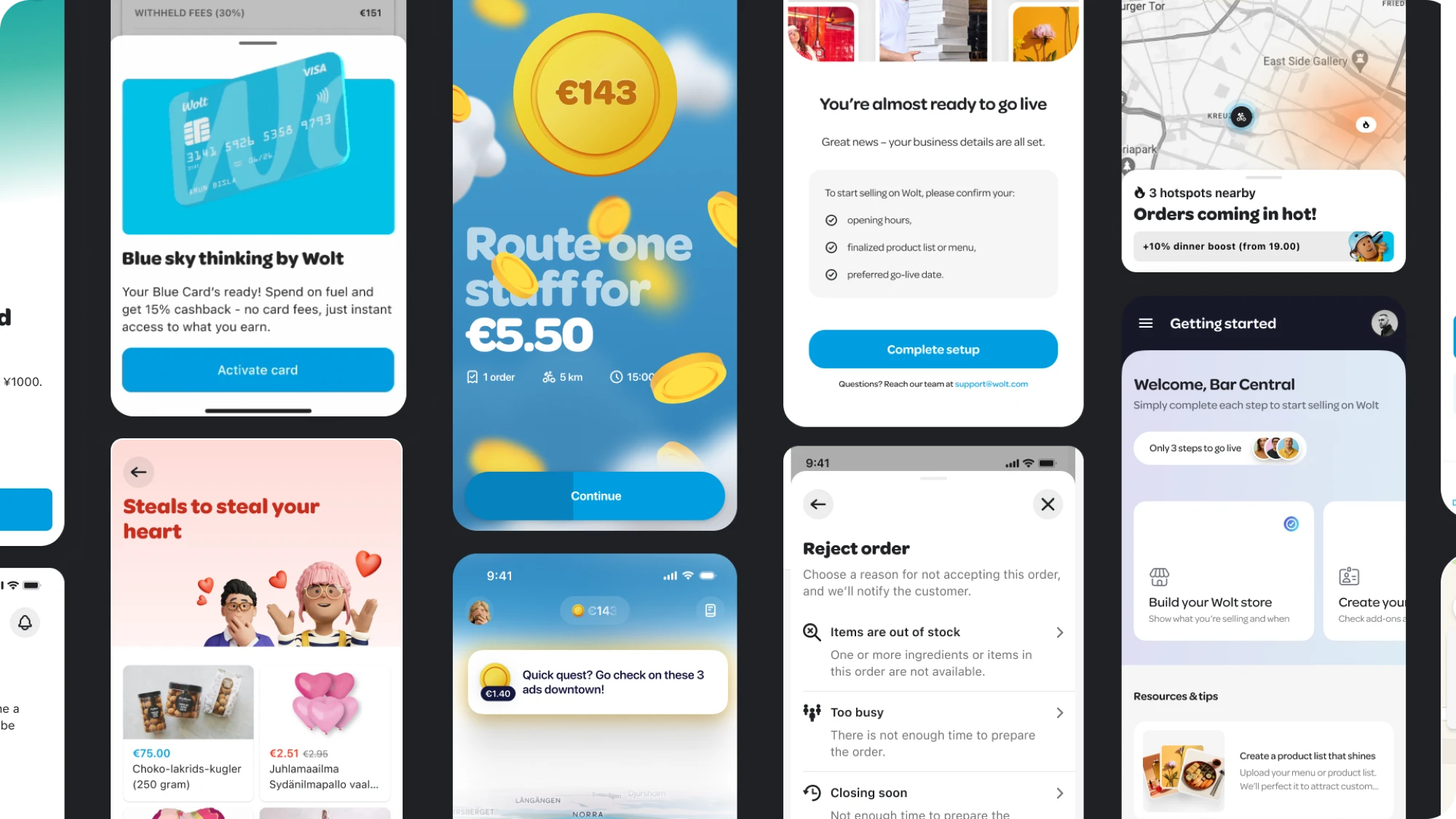
The problem
A loosely defined voice, and AI copy that sounded nothing like Wolt
Wolt’s voice was strong and recognizable. People knew it when they saw it, but no one could say exactly what made something sound like Wolt. The brand guidelines described it as clear, friendly, and professional, but they were written mostly for marketing, with a short section on product.
For product, we also had UX writing principles and a style guide. That worked well while content designers wrote most of the copy, but Wolt was growing faster than its small content design team had capacity for. Copy was increasingly being written by designers, PMs, and AI tools, and they needed more: hands-on examples, and the whys and hows behind each choice. Without that depth, feedback often came down to personal taste.
What we heard
“This copy doesn’t feel Wolt-y enough. Can we make it Wolt-grade?”
“I asked ChatGPT to write it, but it sounds very 🤖.”
“Just write that it’s seamless.”
“I’m not a fan of this. It doesn’t sound right.”
If we couldn’t define “Wolt-grade” in detail, a designer couldn’t aim for it, and neither could a model. With more and more copy drafted by AI, the product started to read like it was written by different companies, which put the brand at risk and gave localization an inconsistent source to translate from.
As part of DoorDash, the guidance also needed to align with DoorDash’s content standards as closely as possible, while staying distinct enough for Wolt’s international markets.
Our goal
Product tone of voice guidance that’s systematized and foolproof.
It had to be easy for anyone writing copy to pick up, and structured enough for any AI tool to follow.
The process
Deciding what to keep and what to build
Before any tool could work, the voice had to be specific enough to teach. I started with an end-to-end audit of the consumer experience, from onboarding, growth, and checkout to discovery, rewards, and memberships.
For each area, I documented its key jobs, where the tone was today, where it should go, and why. I looked at where the copy was already naturally leaning, which screens had to handle sensitive legal or financial information, and where there was more room to push the tone. That map later fed into our AI tools too, so they know when to be careful and when they can have more fun.
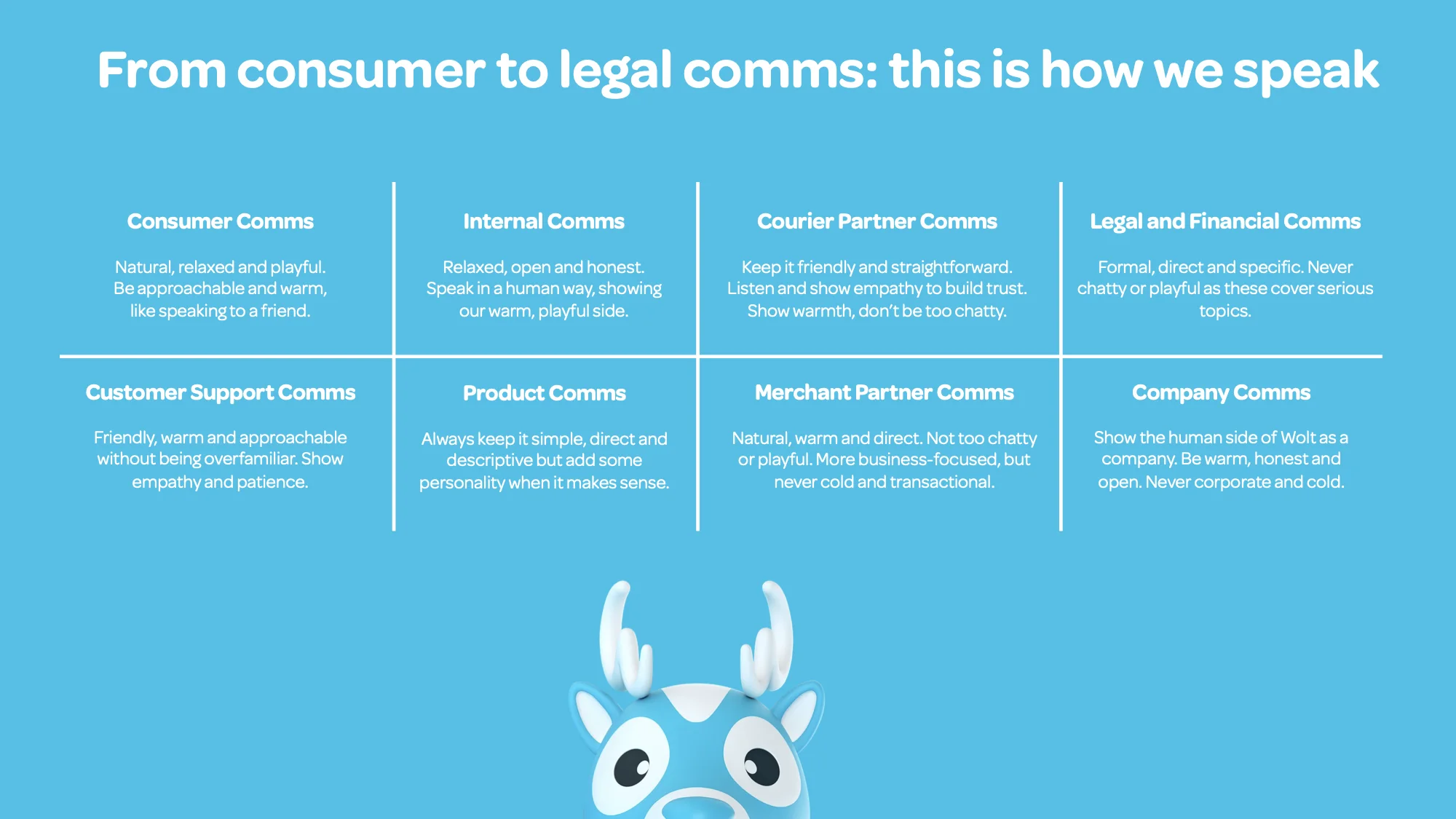
I then led the same process with the content designers who owned merchant and courier. Together we built an overview of each domain, showing where they were similar and where they drifted most.
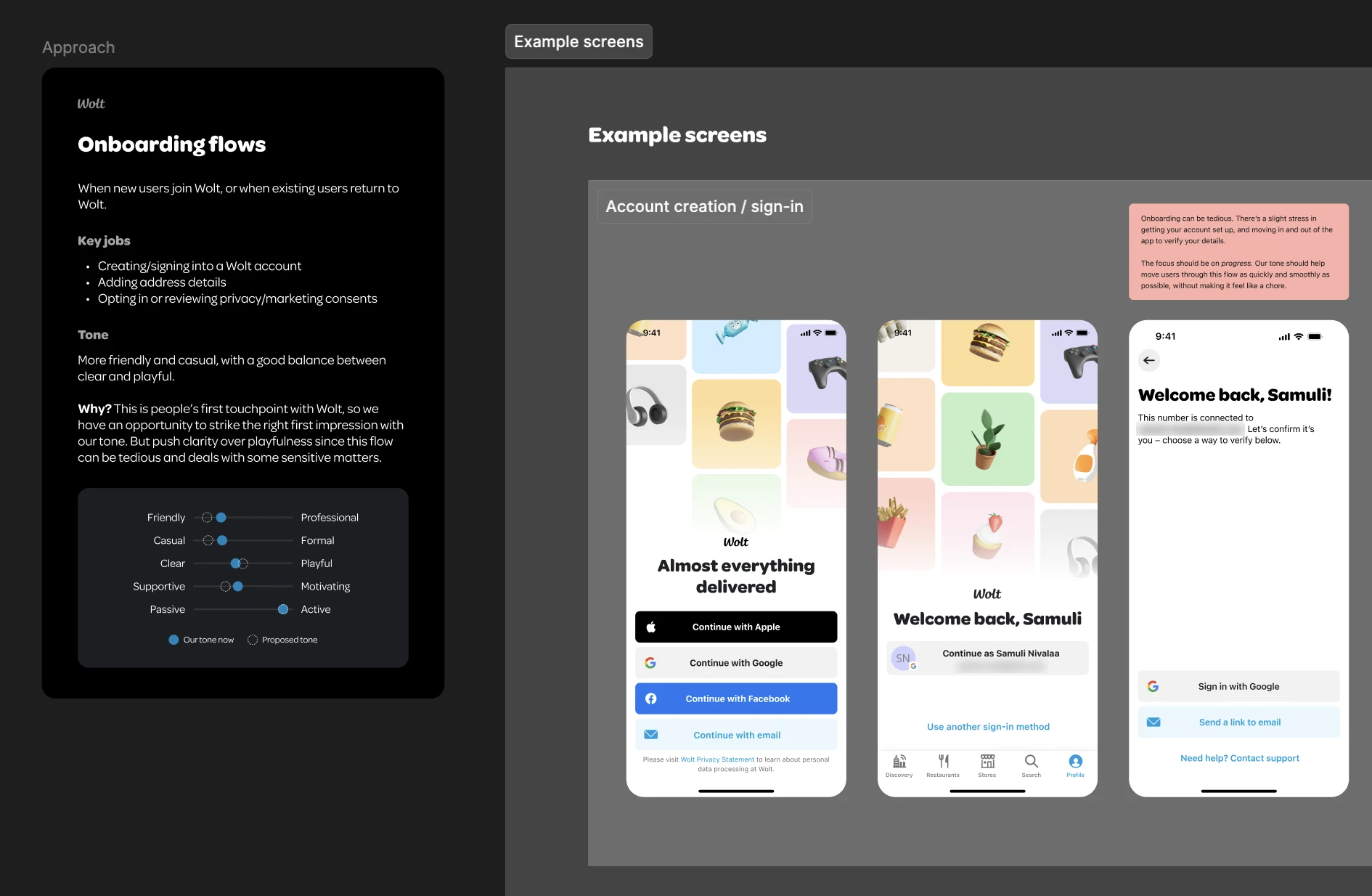
From there, we workshopped the content principles and voice guidelines together. In the end, my biggest decision was to keep the brand voice as it was, and build the product layers on top of it.
Clear, friendly, and professional still worked. What it needed was deeper guidance for applying it in product. Rewriting the voice would have given marketing and product two different personalities, and reopened a brand discussion we didn’t need to have. Keeping it meant everything new built on something people already knew, and nothing in the product voice guidance would contradict the brand guidelines. That consistency also mattered for what came next: the voice guidance would become the source of truth for our AI tools.
The framework
Four layers of guidance
To make sure our product voice fit with the rest of Wolt’s design principles, we built the tone of voice guidance in four layers. The outer ones set how the whole product should feel, and the guidance gets more specific as you move in, down to how a single line should sound.
We kept the experience principles as they were, rewrote the content principles, redefined the voice as pillars, and created the tone scales from scratch.
Framework layers
-
Experience principles
Playful, Snappy, Familiar, and Rewarding. They guide every touchpoint, from motion to visuals to copy.
-
Content principles
The writing rules that translate our experience principles into words, written for each domain. For example, “Say the most with the least.”
-
Voice
Clear, friendly, and professional. Our shared brand personality. Always on, always recognizable.
-
Tone
Real life needs nuance. Nine tone scales help us fine-tune the voice for every piece of copy.
The tone
Giving the voice a range
We broke each voice pillar into three scales, nine in all, like plain to complex or calm to enthusiastic. Both ends of every scale have a definition, real examples, and writing techniques, so anyone can pick a setting, and a model can use the same one.
Each domain has its own baseline tone, informed by its users’ context. Couriers are in the middle of a shift, merchants have a business to run, and consumers just want their order. The settings differ, but it’s all still recognizably Wolt. Localization shaped them too: couriers have a wide range of language levels, so their baseline stays earnest and everyday, with no wordplay.
Baseline tone by domain
Clear
We’re direct, not blunt
- PlainComplex strongly plain
- TactfulCandid leans candid
- RelaxedUrgent leans relaxed
Friendly
We’re fun, not fluffy
- CasualFormal strongly casual
- PlayfulSerious strongly playful
- CalmEnthusiastic leans enthusiastic
Professional
We’re capable, not insecure
- PartnerMentor strongly partner
- ReassuringMotivating balanced
- CommunalIndividual strongly individual
Example“It pays to have friends. Invite friends and get €20.”
Switch tabs to compare domains.
The baseline is a starting point. From there, tone depends on the experience, component, or intent. Below are two consumer messages that both carry bad news, at opposite ends of the tactful to candid scale. The techniques underneath, like active or passive voice, verb choice, and what to cut, give everyone, including a model, the same definition of “candid.”
Tactful vs. candid tone example

- Passive voice to soften the blow, when needed
- Focus on the fix, not the mistake
- Think about the user’s state of mind

- Direct, active voice
- Definite verbs like is, won’t, and can’t
- No hedging. “Your payment didn’t go through,” not “It looks like your payment might not have gone through”
The tools
From guidelines to a content GPT
Once the voice framework was established, we put it to work in three parts: guidelines people could learn from, a GPT that writes with them, and testing to make sure it held up.
Understand
The guidelines live in the design system docs, with examples for every key component. We also explain the reasoning behind every rule, so a designer or PM can see why we soften an error message or cut a hedging phrase, not just follow the rule. For example, we never say “free delivery.” We say “€0 delivery fee,” because “free” counts as a regulated claim in many markets.
I worked with the Design Systems team to document everything and set up a governance plan, so the guidance could keep up with the product without relying on any one person. The content design team owns it day to day, with a process for making small updates directly in GitHub. Bigger changes go through regular check-ins with Design Systems.
Write
I built a Wolt-wide content GPT from scratch, working with designers on what they needed from it. We rewrote every guideline in an AI-readable format, with examples and tricky edge cases. Then we gave the GPT the tone of voice, a revamped product glossary, the style guide, pattern rules for things like error messages and emoji, and a knowledge base for each domain. We also started building a Figma AI plugin that suggests tone by content type and journey stage.
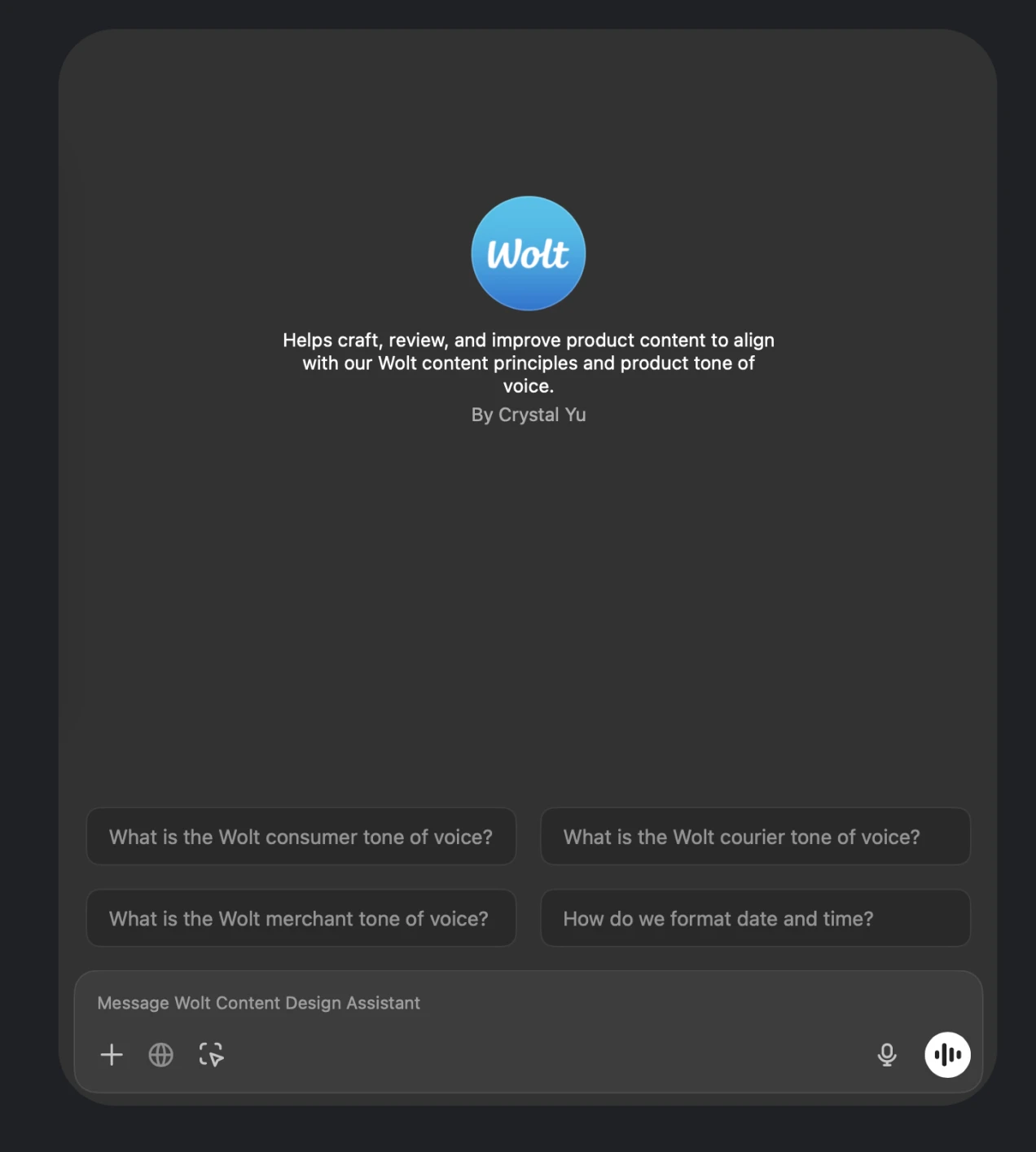
The GPT works in two modes. In strings mode, it drafts or revises copy, runs it through a compliance check, and explains why each choice works, so designers learn the rules as they go. In prompt composer mode, it turns a rough request into a structured prompt. When context is missing, it asks up to three clarifying questions, starting with who the copy is for.
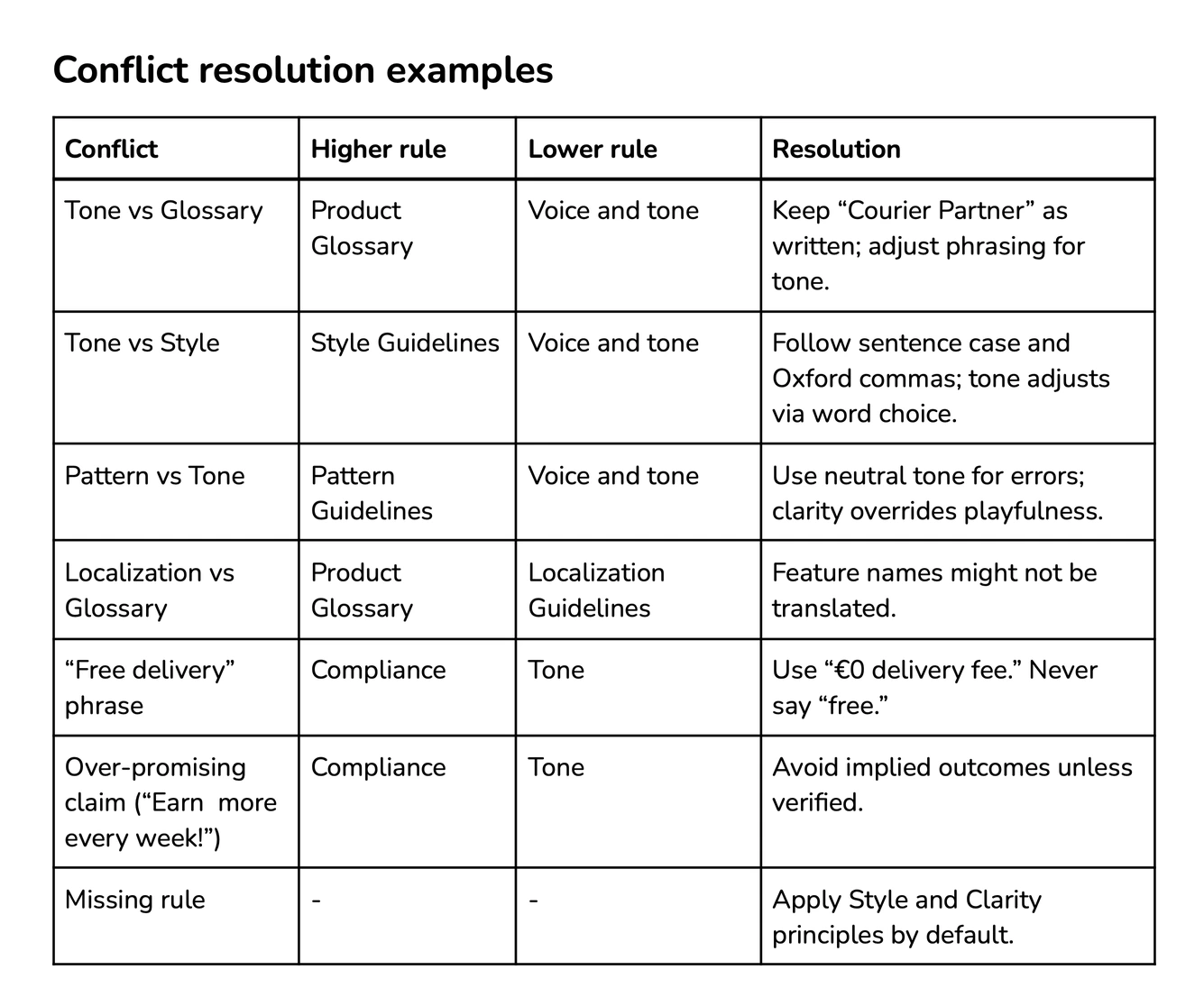
When rules conflict, it follows a rule hierarchy I wrote: the product glossary first, then style, then compliance and legal, then voice and tone, then pattern and localization rules. Tone can change the word choice, but it can never rename a product or make a regulated claim, and an error message stays neutral even in a playful domain. It also won’t promise outcomes like “earn more every week.” If a request breaks a rule, it says no and suggests a compliant alternative.
Test
Handing a model the guidelines wasn’t enough to get it on voice, so I set up A/B tests around three questions. Would more specific, structured instructions improve the output? Would clearer guidelines with explicit examples? And which model handled tone, context, and localization best? We ran real screens from every domain, and from support, through each setup.
To compare them, we built a scoring rubric with eight criteria, each rated from 1 to 5. The primary criteria decide whether users can understand and act, so they needed a 4 to pass. The secondary ones, like tone and brand consistency, needed a 3.
Output scoring criteria
Primary criteria
Can users understand it and act on it?
Passes at 4 or higher
- Structure
- Key points stand out and are easy to scan.
- Clarity
- Clear, concise, and instantly understandable.
- Context
- Fits the moment, the task, and what the user needs.
- Compliance
- Meets legal and policy rules, with no risk.
Secondary criteria
Does it sound like Wolt, every time?
Passes at 3 or higher
- Brand
- Sounds like Wolt and needs no edits from a content designer.
- Tone
- Matches the moment, like calm in errors and upbeat in success.
- Style
- No errors, and fully in line with the style guide.
- Consistency
- Similar requests get the same voice, format, and structure.
Select a score to see what it means for each criterion.
Two changes made the biggest difference: more structured instructions, and the rule hierarchy. I also rewrote the rubric along the way. The first version focused on grammar, brand, and creativity. The new one judges copy the way a content designer would, with structure, clarity, and context first, and tone split out from brand. Then we kept refining the prompts with designers’ feedback until the drafts were reliably most of the way there.
In practice
During the pilot, we tested the GPT with product teams that needed new copy, including cart and checkout, and memberships. Both teams drafted their strings with it and shipped with little or no content review.
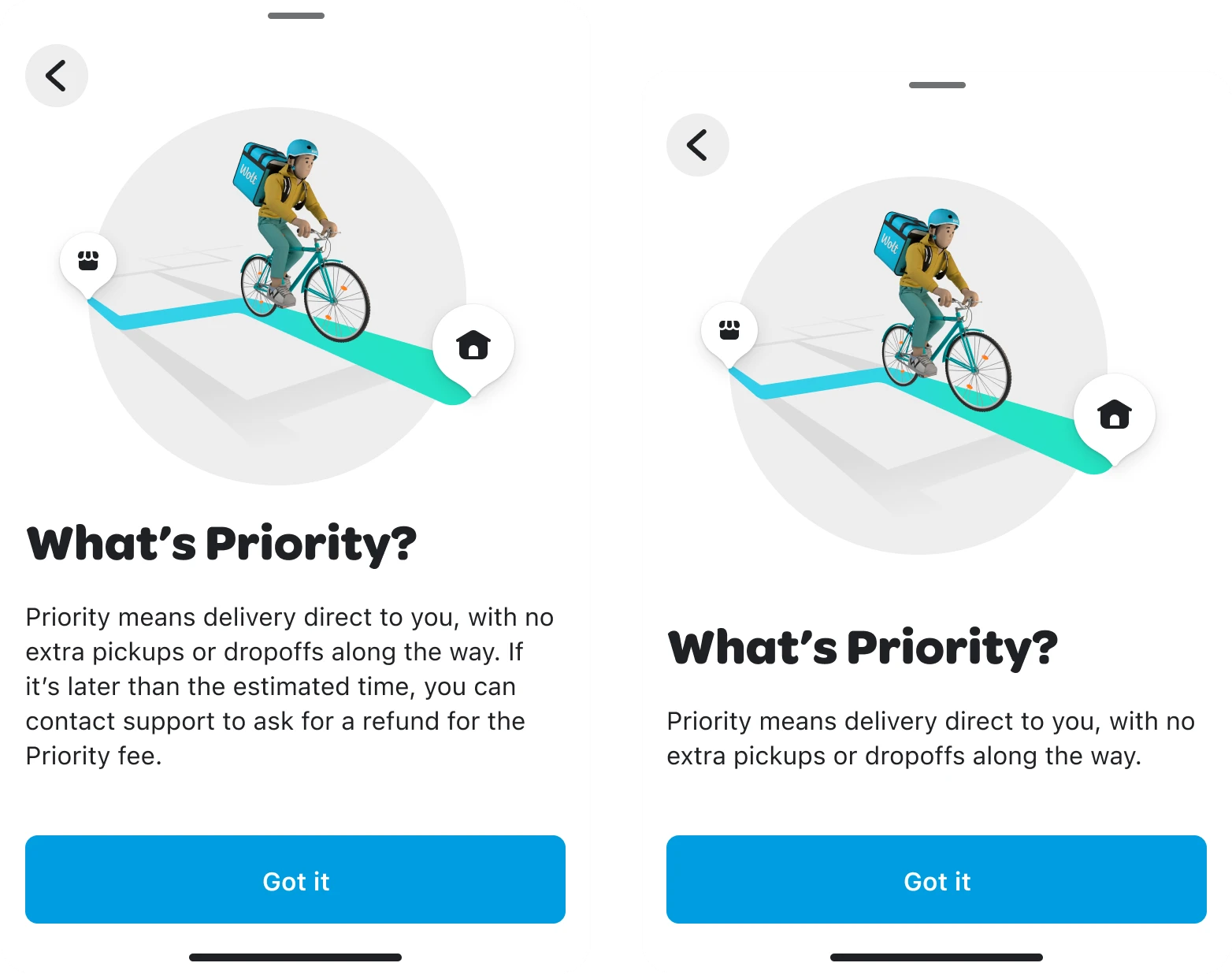
Here are two real requests from designers, one to review copy and one to write it. We ran each one through plain ChatGPT, then through our GPT. Our GPT is built on ChatGPT too, so the difference comes from the guidance we gave it.
AI output before and after our guidance
Prompt
“Can you evaluate these?”
Before
After
Suggested rewrite: “Priority means delivery direct to you—no extra pickups or drop-offs, just the fastest route.”
- Grammar
- Pass
- Capitalization
- Check feature name
- Terminology
- Verify “Priority”
- Tone and clarity
- Pass
- CTA
- Pass
- Policy
- Needs confirmation
Prompt
“Can you rewrite the errors in this screen according to best UX writing principles?”

Before
After
“The store is closed right now. Please try again later when the store is open.”
“Store is closed. Check back when the store opens.”Button: Got it
“Oops! Something went wrong on our end. Please try again in a moment.”
“Something went wrong. We couldn’t complete your request. Please try again.”Button: Try again
“You’ve already checked in today. Please come back again tomorrow.”
“You’ve already checked in today. Come back tomorrow to check in again.”No button
In the review, ChatGPT suggested promising “the fastest route,” a claim we can’t make. Our GPT scored each element and flagged the feature name and refund policy for a human to confirm. In the rewrite, plain ChatGPT mostly smoothed the wording, while our GPT gave each error a real title and the right button.
The impact
Adopted by every designer, and built to grow
After the pilot, we rolled the content GPT out to courier and merchant, until every product designer had it, around 40 people. Teams started using it as soon as they had access, and PMs and engineers picked it up too, since there were so few content designers to go around.
Copy requests to content design dropped by over 80%, from about 50 a week to under 10. Designers could ship without waiting on us, with less back and forth and fewer consistency issues to catch. And the content team got that time back to fix systems-level problems instead of single strings. Soon marketing and other teams were asking to build GPTs of their own.
For users, the copy is more consistent from one part of the app to the next, and localization starts from a cleaner source in every market.
Feedback can now point to a specific tone setting instead of a gut feeling, and the framework a new designer reads on their first day is the same one we give to a model. Because every layer builds on the same core voice, the system can keep growing, with new domains, tone examples, or AI tools, without putting that foundation at risk.